|
Q: Why the title "Wind Chains" for your new album?
MZ: It is the battle to not hold yourself back; to not let others
hold you back mentally or physically – that you don’t
need the chains that we put on ourselves.
Q: I heard a lot of great comments about the artwork on "Wind
Chains".
MZ: (smiles) Oh good. We spent a lot of time going through and
making sure that this was how we wanted it. It’s all in a
water theme. I wanted the background vocals in so people weren’t
in the dark… and of course all of the lyrics – even
if a few of them are incorrect.
Q: Maybe that’ll make this first pressing a collector’s
item.
MZ: (laughs) But there are abstract elements done in the photos
and little things that people can find in it. There’s my
written dream language hidden in there, and symbols of space and
stars and planets and time and planes and words and all these
things that hold so much meaning to the album and the songs and
me. I don’t want people to only look at things once and see
everything that’s there. I want them to be able to spend
a lot of time with this - to go into depth - and to make it more,
well, me.
Q: In each CD there’s a beautiful, wispy leaf.
MZ: Yes. It’s a skeleton leaf.
Q: Skeleton Leaf? What’s that? Does it have a special symbolism
to you?
MZ: The beauty of its lightness and how easy it would just blow
away. I’ve seen people open the cases in front of me and
the leaf just fall out.
Sometimes they don’t notice, and I pick it up for them. And
a lot of people come up to me later and ask, “Does everyone
get these leaves? That’s so wonderful and beautiful.”
That’s what I wanted - to be able to touch people with that.
The first album we went more straightforward by including a sticker,
but for Wind Chains, I wanted to go more abstract, like the album
is in terms of being more of an art piece in general – the
entire package, not just the music. Things are hidden in it. I
wanted the packaging to have that same edge. I wanted people to
be purchasing not just music when they bought it.
Q: If you described "Wind Chains" as a color, what
would it be?
MZ: That’s an interesting question and surprisingly a lot
of people have
asked me that. I think it goes into quite a spectrum, actually.
Some of the first colors that come to mind are purple and blue,
but I feel that it
covers all the seasons. It’s quite a weather album in my
mind. It has red
and orange and yellows and greens, but I still try to stay with
a water
theme even though it does cover all these different emotions,
because it’s about a circle, And in that circle there’s
not just one color. You have to go through the entire spectrum;
you have to go through all the seasons and everything to complete
it.
Q: While we were getting set up for the interview, you mentioned
something that I want to get back to - about how you feel your
music comes from other planes or other levels, and that you sometimes
see yourself as an interpreter of sorts.
MZ: They follow me.
Q: Who’s they?
MZ: Planes. Different ways of looking at things. It’s my
choice to look
at them. Whether or not I want to look at what’s going on
between you and me right now, although it seems perfectly clear,
whether or not I choose to focus on what’s happening between
us is a decision I can consciously make, or not. But if I consciously
make it, I can’t… I don’t know…I’m babbling…
Q: (observation - Molly gathers her long hair in her hands and
with a few quick twists of the wrists has it wound into a spiraled
tail which she ties in a single, thick knot at the base of her
neck. The interim seconds
regroups her thoughts).
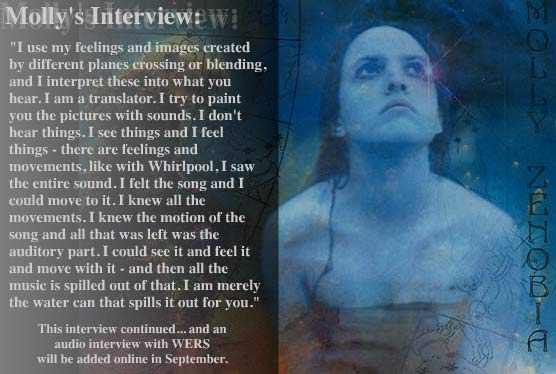
MZ: I use my feelings and images created by different planes
crossing and blending, and I interpret these into what you hear.
I feel sometimes like a translator. I try to paint you the pictures
with sounds. I don’t hear
things. I see things and I feel things – they are feelings
and movements,
like with my song Whirlpool, I saw the entire sound. I felt the
song and I could move to it. I knew all the movements. I knew
the motion of the song and all that was left was the auditory
part. I could see it and feel it and move with it – and then
all the music spilled out of that. I am merely the watering can
that spills it out for you.
Q: Your piece Whirlpool has some characters that are recognizable
from myths…
MZ: (smiles) Yes, it does. I love using mythical characters to
help circle
where I am now. Psyche, Cupid, Poseidon, King Midas, King Aeolus,
the god of sleep, the god of hunger…
Q: Why draw from myths instead of things that are very familiar
like the
pop icons of today’s culture?
MZ: Well, that would probably be the result of my parents, who
raised me on myths and stories, and things like that; And that
I am drawn to history and myths. I experience contemporary things,
but since ‘history will repeat itself’, so to speak,
I can use distant places and times and histories to connect to
me today. It’s easier to see the circles and the spinning
and the connections from a greater distance. Sometimes you’re
too close to see what you’re looking at.
Q: Do you think that’s the function of your music then –
to transfer those feelings of ‘spinning’ and put them
under the control and order of ‘art’ so you can ground
yourself?
MZ: I have friends who tell me I should be very careful with
astral
projection because they think I wouldn’t be able to find
my way back to my body. But I manage. (laughs) I find that I need
to ground myself, and my music is definitely something that lets
me leave but also keeps me there. It’s the leaf in my windstorm
and the chains that keep me from losing myself. And cooking does
that. Often times when I can’t find myself, I’ll cook.
And one of my friends loves when I cook like that because she
said that whatever emotion I have comes out in the cooking.
Q: Like Water For Chocolate.
MZ: (smiles) Yes. In a way. Cooking’s a healing process
for me. We made an orgasmic pizza once. That was the description
for it anyway, and another time I made this one dish - I just
totally invented it and this friend of mine was bouncing around
and laughing and she stops and looks at me and was like, “I
feel like I just had a bottle of wine!”
Q: So, if something like cooking grounds you, what happens when
you want to go to the opposite ends, do a 180 from being grounded
and talk to your muse, when you’re looking for inspiration,
maybe struggling with finding closure to a new piece?
MZ: Some pieces are very stubborn. But I let them be, and I say,
“Fine if you’re going to be stubborn, then you can come
to me when you want to talk to me.” And I’ll leave them
alone, and they’ll usually come back… because I think
I’m more intriguing than sitting there all by themselves.
(laughs) But I don’t think inspiration is very hard to find
in this world. There’s so many talented people and so many
amazing and moving things happening around you that you just have
to look at them, and if I’m not being inspired it’s
most likely that I’m not opening my eyes to that.
Q: What do you want people to come away with after hearing you
play, or hearing your music?
MZ: I want to give people something to hold on to. I use my music
and I put it out as a part of me that I want to share. I want
people to be able to find a part of themselves that they lost
or a part of themselves that they’re hiding from or even
looking for. I hope people can take a piece of what I’ve
given them and it makes them want to go to their instruments,
and it makes them want to create. I hope that I can give people
the movement to creation and the vision to be able to see it.
Q: What’s the hardest part of creating?
MZ: Being truly honest with yourself. Looking at yourself that
closely,
and admitting what’s really painful, or what’s honestly
wrong, maybe
something that I’ve done wrong or reliving a situation that
was very
difficult. You know it’s still buried in you, and you have
to find a way to
release it. I feel that a lot of my songs are created because
there’s so
much emotion flying around that I finally need to ground myself
so I don’t loose myself in it, and I can release through
a song, which is often times me in tears, but it’s the one
thing that can honestly heal me and not let me hide from myself
or my emotions. A lot of times it’s not as easy to call a
friend, or as cheap (laughs)… if my friends are far away.
And I’m not a person that needs words when I’m hurt,
I need a hug or a hand, or to paint or to just let it out with
color. Or finger-paint.
Q: Or the touch of the piano keys?
MZ: (smiles) Yes. Just something that lets all of it live where
it is and
doesn’t try to force it to be somewhere else.
Q: What advice would you give to other people that want to create?
MZ: I think the best thing that I did was not looking at something
and say, “Oh, I want to do something like so-and-so."
The best advice I have is to stop, look at yourself, and be completely
as dead honest as you possibly can to what your voice is. Surround
yourself with things you love, something that draws you to create…
whether it’s a song, a painting, a poem, a book, a person
you met… And yes, you can write a song like so, or you can
sound like this, or it would be cool to sound like that, but to
be that honest to yourself is what would heal you the best and
be you the most. I feel that in the end, although it may be the
most difficult, it’s the most gratifying.
Q: How many hours a day do you work at your craft?
MZ: Well, we’re not supposed to admit this. I’ve been
told that we’re
supposed to say, “Oh no, I don’t practice at all. It
just comes to me.”
(laughs) But, honestly, if you want to be a musician you practice
as many hours as you can fit and not hurt yourself. What you’re
doing is you’re creating a vocabulary for yourself. Very
much like writing. When you sit down to write, and a poem comes
to you, you’re coming from what you’ve experienced and
what you know and what you’re able to express, and the same
is true for music. You can't use a word you've never learned.
You practice playing this type of scale or that type of chord
and work on how to change them, work inside them, so that when
that time comes that you’re ready to spill out and talk,
you’re hands know how to communicate what you want to say
in the way you want to say it.
Q: I’m always curious if artists have special objects around
for
inspiration, like a talisman?
MZ: Yes, for me at least. I surround myself with things that
have meaning to me. Like there was a point when I made a large
circle in my room of special things and I would work within the
circle – do my writings…
Q: What do you mean, “special things in the circle?”
Like what?
MZ: Shells, my rock collection, my bone collection. A few people
have made me things that are very small and very beautiful, and
I keep them out always. My God, I could keep going. I have old
keys. I have old piano keys. Things that used to belong to my
grandmother Zenobia. Different charms and herbs and things that
make me feel safe. Paper cranes. Books. OOOOO, I love books. Oh,
and I was going to say that one of my favorite gifts to get are
books, and when I find that someone wrote something inside the
cover, something very special, I love it. I melt. I’ll love
you forever… if it’s a good book. (laugh)
Q: If you were going to be stuck on a desert island, what is
the one book that you’d have to have with you?
MZ: I’d probably have the complete works of Shakespeare,
so I’d have something to do (laughs)… re-enact all of
them.
Q: Favorite poem?
MZ: Mmmm… “The Anvil”, by Mark Van Doren.
Q: Okay. Now I think it’s time we really get serious. What’s
your
favorite movie? Or what films are in your own video library?
MZ: Mmmm… Fight Club, Death Becomes Her, ah… Chicken
Run, A Bug’s Life, Fried Green Tomatoes, Long Kiss Goodnight,
Dancer In The Dark, Being John Malkovich, mmmm… Labyrinth…
Romancing The Stone… I have so many favorite movies…
I think I’ve seen Being John Malkovich the most, but I like
them all in their own special way.
Q: Your Favorite super-hero?
MZ: Ooooo, these are good questions! Ghost Rider and Wolverine.
Q: I think I knew that one. Why are they your favorites?
MZ: Because I am them! And Indiana Jones.
Q: He’s a super-hero?
MZ: (vehemently) Yes!
Q: Ok. Favorite fast food?
MZ: Boston Market. Oh, God. It’s just so good and so bad.
I can’t
explain it. It’s a phenomenon.
Q: If you had to pick one thing that you do every day and eliminate
it,
what would it be?
MZ: Procrastination.
|